In addition to using mathematical methods to calculate and analyze the frictional torque of rolling bearings, empirical formulas for calculating bearing frictional torque were obtained through experiments on various types and sizes of bearings. These experiments were conducted under conditions ranging from light to heavy loads, medium and low speeds, and using different lubricants and lubrication technologies.
To evaluate the experimental results, the frictional torque was measured under different loads, different lubricant viscosities and filler amounts, and different bearing speeds. The results showed that even under heavy loads, the influence of frictional torque primarily depends on the mechanical properties of the lubricant at the contact point between the rolling elements and the raceway. However, to simplify the analysis method, the main factor generating frictional torque is still considered to be the applied load.
01 Torque caused by external load
The frictional torque is described by the following formula.
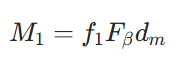
In the formula, f1 is a coefficient related to the bearing structure and load.
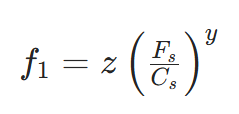
In the formula, Fs is the equivalent static load, and Cs is the basic rated static load. Table 1.1 lists the values of z and y. The value of Cs and the data for calculating Fs are usually given in the manufacturer’s catalog.
Table 1.1 Values of z and y
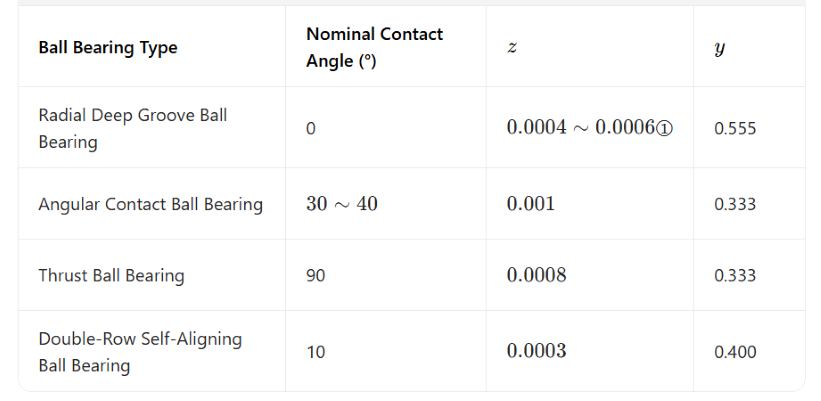
① The smaller value applies to light-duty bearings, while the larger value applies to heavy-duty bearings.
Fβ=0.9Factnα−0.1Fr or Fβ=Fr
The above formula uses a larger Fβ value. For a deep groove ball bearing with a nominal contact angle of 0°, the first formula above can be approximated as:
Fβ=3Fa−0.1Fr
For thrust ball bearings, Fβ=Fr.
02 Torque generated by viscous friction of lubricant
For bearings operating at medium speeds, the following empirical formula can be used to calculate the frictional torque generated when the rolling elements pass through the viscous lubricant inside the bearing cavity:
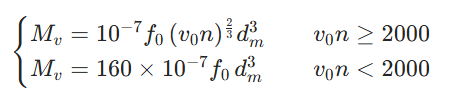
In the above two formulas, vo is in centistokes (cSt), n is in r/min, and fo is a coefficient related to bearing type and lubrication method. Table 1.2 lists the latest data, giving the fo values for various ball bearings under different lubrication conditions. The above two formulas are valid for lubricating oils with a specific density of approximately 0.9. A more complete formula is given for lubricating oils of different densities. For grease-lubricated bearings, vo refers to the kinematic viscosity of the base oil in the grease, and this formula is valid for a short period after grease application.
Table 1.2 Relationship between fo value and ball bearing type and lubrication conditions
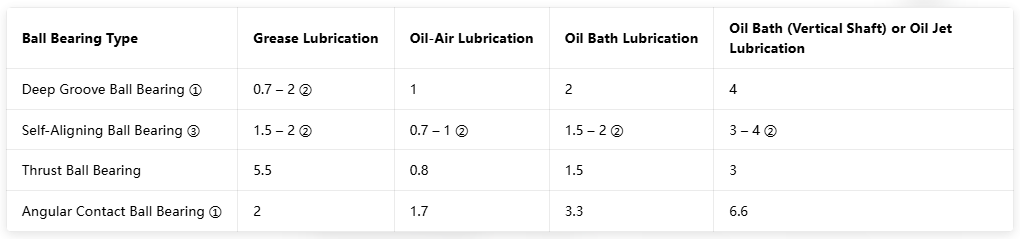
① Use 2fo for paired or double-row bearings.
② Smaller values apply to light-duty bearings, larger values apply to heavy-duty bearings.
③ Only applicable to double-row bearings.
03 Total frictional torque
Under moderate load and moderate speed conditions, it is reasonable to determine the rolling bearing friction torque by using the sum of the frictional torque caused by the load and the viscous frictional torque, that is:
Since M1 and Mv are based on empirical formulas, they also include the effect of the rolling elements sliding in the cage pockets.