
Author: Japan Factory Union
Ball Bearings and Roller Bearings
Ball bearings and roller bearings are the two core types of rolling bearings, widely used in the machinery field. They have significant differences in structure, load characteristics, and application scenarios.
01
Kugellager
Ball bearings use balls as the rolling elements. They are mainly categorized into Deep Groove Ball Bearings, Angular Contact Ball Bearings, Thrust Ball Bearings, etc.
1
Rillenkugellager
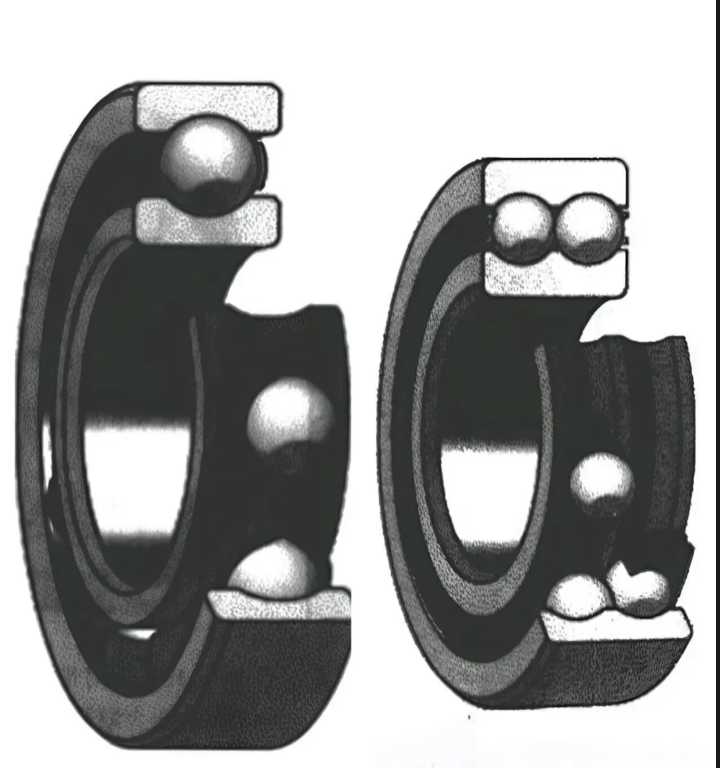
Deep Groove Ball Bearings can accommodate radial loads, as well as a small amount of combined radial and axial loads. They have high limiting speeds and low starting torque. Among these, single row deep groove ball bearings are widely used. Single row deep groove ball bearings with filling slots have a higher radial load capacity but are not suitable for axial loads. Double row deep groove ball bearings have a higher load capacity. Instrument ball bearings have a specific size range and stricter manufacturing standards.
2
Schrägkugellager
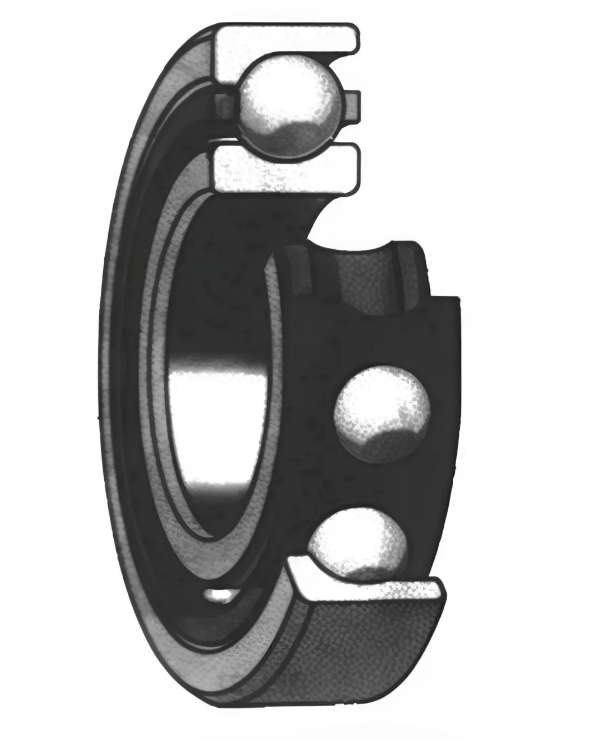
Angular Contact Ball Bearings are suitable for accommodating large axial loads, or combined radial and axial loads. The larger the contact angle, the higher the axial load capacity. They are often mounted in pairs to eliminate initial clearance. They can also be mounted in tandem to increase axial load capacity.
3
Thrust Ball Bearings
Thrust Ball Bearings typically have a contact angle of 90°. They are suitable for high-speed operation. Some types feature a spherical housing ring to allow for external self-alignment. However, when the contact angle is 90°, they cannot accommodate radial loads.
02
Rollenlager
Roller bearings are generally used in applications where loads exceed the capacity of comparably sized ball bearings. Compared to same-size ball bearings, roller bearings typically have higher rigidity (less deformation per unit load) and better fatigue resistance. Generally, the manufacturing cost and price of roller bearings are higher than those of same-size ball bearings, and the requirements for installation and use are more demanding. Except for spherical roller bearings, care must be taken during installation to ensure the concentricity of the shaft and the bearing housing.
1
Radial Roller Bearings
Within radial roller bearings, Zylinderrollenlager are suitable for high-speed operation due to their low friction torque. This type of bearing also has a high capacity for radial loads. Needle Roller Bearings have rollers whose length is much greater than their diameter. They are suitable for applications with limited radial space, but have higher friction.
2
Kegelrollenlager
Single row tapered roller bearings can accommodate large radial and axial loads, or thrust loads alone. Due to the different contact angles of the inner and outer raceways, a contact force exists between the roller and the inner rib. Because of the relatively high sliding friction at this rib, tapered roller bearings are not suitable for high-speed operation without special cooling and lubrication.
3
Pendelrollenlager
Most spherical roller bearings have an outer raceway that is part of a sphere. Therefore, this type of bearing can self-align internally. In the cross-section perpendicular to the rolling direction, the roller generatrix is a curve that matches the inner and outer raceways very well, giving spherical roller bearings a very high load-carrying capacity.
4
Thrust Roller Bearings
Among thrust roller bearings, Spherical Thrust Roller Bearings have a high load capacity but are not suitable for high speeds. Cylindrical Roller Thrust Bearings and Tapered Roller Thrust Bearings are only suitable for low speeds due to sliding friction. Thrust Needle Roller Bearings simply use needle rollers instead of standard rollers and are suitable for applications with limited axial space that do not involve heavy loads.
